
Last updated: July 8 2023
See also: Directing Radio Plays - Part 2
Directing the MT&R Re-creating Radio Workshops
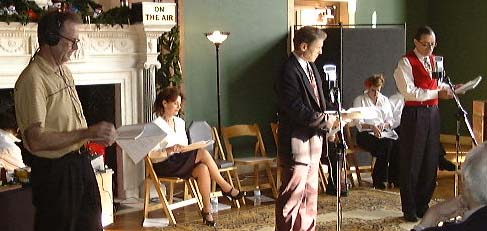
Directing radio drama is more like film direction was during the silent era than contemporary theatrical or film directing. The director stands in front of the actors "throwing cues" and using hand signals to convey ideas like "faster," "more emotion", "stretch it out," "step back from the microphone," and coordinating the music, SFX and dialogue. In radio's golden era, directors would often stand in the sound-proofed control room and cue the actors through a glass window. There was a lot of swearing going on behind the glass as actors or sound effects artists missed cues or bungled a line. Orson Welles would direct--and act--from a podium in the studio, much like an orchestra conductor. I prefer to direct "on the floor", with my cast and crew facing me. I read along as the actors speak and pantomime my instructions to coordinate the actors, SFX artists and engineer (who is triggering music and pre-recorded SFX tracks).
Script Q-ing
I prepare the script ahead of time by marking up the master copy with a large “Q” where dialogue, music or sound effects cues need to look to the director for timing or coordination. For example, after a music cue starts, the cast and crew need to know how long the cue must be "established" before we begin dialogue or sound effects. I also put a "Q" on a dialogue line where the actor must pause for an important sound effect or music cue to finish before continuing their dialogue. For example, waiting for the window to open before they talk about what they see inside the secret hideout. I also put a "Q" on music cues where the engineer must wait for some action to be concluded before the music starts or stops. All actors and staff work from a copy of my "Q"-ed script. When they see a "Q" next to their line or sound effect, they know to look to me to cue them.
I put the scripts in 3-ring binders for the Sound Effects Artists and Engineers. I create a master engineering script by using a highlighter pen and marking how long a music cue will play under dialogue or sound effects. I highlight the music cue in the script, then draw a vertical line through the other dialogue and sound effects cues until I get to where the music cue must fade. My site's engineering page has a representation of a script marked up for music cues. The script is hi-lighted as follows: Pink for music cues (indicating what dialogue and SFX cues they run through), Blue for Reverbed dialogue and SFX, Green for filter effects (telephone or tinny radio broadcasts). Don’t use yellow hi-liters--they are hard to see in low light situations, such as a recording studio control rooms. Similarly, I create a master sound effects crew script where I indicate how long specific sound effects are to continue under other cues. It takes time to create these hi-lighted script books, but they pay off in ease of production.
I keep my own director's script pages in plastic sleeves in a three ring binder--The plastic sleeves make for quiet page turning. When directing, I lay the book out on a table or music stand, which allows me to have both hands free so I can coordinate cues between the sound effects department and the actors and engineer.
Casting
The cast makes all the difference to a radio production, especially in a workshop. Luckily you don't have to worry about what people look like and can often cast someone in several roles. Auditions are essential to getting the best performers in the most important roles. I prepare a two page collection of casting monologues representing the various major characters and have the workshop participants read this over (often aloud), before they audition. I then grade them as to quality of reading (emotion, diction, accents, spirit, etc, and SFX--meaning they belong in sound effects) and list several candidates names for the important roles in the program. For workshop purposes, we have plenty of small roles for those who only want to act--but can't. I usually combine several roles--since it is radio, one actor can easily do several--and can split those off to give to a poor, but determined actor who won't "stoop" to sound effects.
Voice and Sound Effects Training
In the workshops, we have two hours to cast, rehearse, produce and playback a 25 minute radio show, which does not allow me the luxury of sitting around doing the traditional first table-reading so common to stage productions. Instead, I gather the actors and sound effects artists together and quickly tell them the story of the program--and to insure I have their full attention, I do this before I have let them know the casting decisions. People pay much better attention to the story when they're not focused on their role. It is especially important that the SFX artists understand the story since they will be providing the sounds of the action.
After the story run-through, I announce the casting and pass out the actors' scripts, which already have their character's lines highlighted, (preferably in green or pink, since those colors show up best under nearly all lighting conditions), and send the sound effects artists into the studio for training by our sound effects chief. I then instruct the actors to read over their highlighted lines and practice the "mechanicals" of the performance--saying the lines out loud five to ten times in a row. This helps the actors get their tongues used to forming the words.
While the actors work on the mechanicals, I visit each one and explain their character's history and motivation. I also help them with names or difficult pronunciations and suggest attitudes to use behind their lines. For example: Tonto is brave, he doesn't speak well, but knows a lot about tracking and Indian medicine. He's funny too.... These broad "notes" are about all we'll have time for in a radio production. We don't do a formal "first reading." We will do that in the cue rehearsal.
Meanwhile the Sound Effects Chief is training our SFX artists. We use from three to five SFX artists on a show because our workshops generally have 20 people in them. The real old-time radio shows would only have two or three SFX people and one of them was usually dedicated to playing sound effects from records. We often use only manual sound effects so there's plenty for everybody to do. Although the pros used to regularly do two or more sound effects at once, we make sure one artist never has to do more than one effect at a time.
In preparing our scripts for a show, we divide the sound effects cues between three to five SFX artists and highlight several scripts with five different colors (blue, yellow, green, pink, orange) usually indicating when an effects starts and ends--like a musical score. Then for production, we assign each SFX artist a color and they are responsible for their producing the sound effects highlighted with their color.
The Sound Effects Chief goes down the list of each sound effect called for in the show and demonstrates how to produce the sound. Each SFX artists learns how to produce their assigned sound effects. After all sound effects have been demonstrated, the Chief begins to go through the script, sound effects cue by sound effects cue, practicing to deliver either single effects or coordinating cues where several effects are used simultaneously. In the limited time allocated for this training, the crew may not make it through all of the sound cues, but the rest will be covered during the cue rehearsal. In the rehearsal and live performance, the Sound Effects Chief assists in cueing the SFX artists and coordinates cues from the show's director.Radio Skills School
In workshops, just before we begin the cue rehearsal, I call the cast and sound effects crew together to explain radio drama production.
Microphone Technique:
1) Sensitive and dead areas. Don't touch the mike OR the stand!
2) Proximity effect. (It's sounds too boomy if you're too close.)
3) Proper distance for radio acting. (10-18 inches)
4) Dynamics and distance. (Back off to yell or scream.)
5) Off mike use for distant sounds or asides. (Step back to convey distance)
6) Popping “P”s and S-S-S-Sibilance. (Speak over or under, not into the mike)
7) Mike safety. (No hitting, blowing into, or dropping)
8) Assume every mike is always ON. (Don't curse in a studio, ever!)
9) Turn script pages quietly. (Off mike.)
Radio Acting:
1) Quiet in the studio.
2) Don't cough, laugh, or talk during production.
3) Turn your script pages quietly--off to the side.
4) Watch the director. Wait for your cue. (Q)
5) Speed equals excitement. Don't bore the audience.
6) Jump in if there's "dead air."
7) Wait for director's signal at the end of performance.
Radio Direction “Sign Language”
1) “Wait.” Open hand.
2) “5-4-3---” Finger count down.
3) “You're on.” Pointing finger.
4) "Faster" Rapid finger circling--like dialing a phone sideways. "Come on!"
5) “Stretch it out.” Pulling taffy.
6) “Wrap it up.” Finger draws circles.
7) “Louder.” Pull ear.
8) “Quieter.” Finger to lip ("Shhhh"-style)
9) “Cut.” Finger slits throat.
10) “Come in” or “Back off” microphone.Cue Rehearsal
A cue rehearsal is used to learn the story, correct delivery and pronunciation and coordinate the dialogue, music and sound effects. It can run slow and sometimes stop, as cast and crew repeat portions of the script until they get the cues “right.” Here the unique radio script format is especially useful. Every cue for dialogue, music and sound is numbered and the numbers begin again with each new page of the script. When the director wants the cast and crew to return to a certain cue, he can just say "Page 7, cue #3" and everybody will know just where to go. As an actor or SFX artist is doing their cue, I often give direction on how to deliver a line ("faster" or "angrier") or produce an effect ("bigger" or "longer"). I often have actors or SFX deliberately step on each other's cues (where possible) to give it a more life-like feel.
If technically possible, I wear headphones for the cue rehearsal and broadcast, so I can also monitor how loud the dialogue, music and sound effects are in relation to each other. When recording or broadcasting live, due to feedback fears, the actors and SFX artists often aren't permitted to hear the music cues during the live performance. With headphones on, I can more accurately time when to cue people.
During rehearsal, I'll constantly be looking to the Engineer and Sound Effects Chief to coordinate cues. Everybody has a script in front of them, but like an orchestra conductor, the director sets the pace and puts emphasis where it is needed. My own personal style is to conduct with wild hand gestures punctuating the dialogue I want emphasized and shaking towards the sound effects artists to get more out of them. It's been developed out of necessity when working with amateur actors and SFX artists. Old time radio veterans get a big kick out my histrionics and I think it adds to the vigor of the performance of the cast and crew. Radio should never be boring and this lends an unseen visual component to my productions.
I work the actors and crew through the script, learning the story as we go. In workshops with amateurs, the one cue rehearsal we have time for is usually terrible--sloppy cues, slow delivery, lack of excitement. No one can believe the program is going to sound good when performed live, but the practice pays off. In the golden days of radio, they would spend 3 hours rehearsing a 15 minute show and they were professionals--just the same, many shows had stars reading their lines "cold" on air! Orson Welles would have somebody else read his lines in rehearsal and then do the live performance himself, which added a freshness to everybody's performance, but that was a special skill. I do about 25 minutes of rehearsal for a 15 minute program. And then play a trick on everybody for the live production.
Performance/Broadcast/Recording
As soon as the cue rehearsal is completed, we reset all music and sound effects cues and prepare for the broadcast. It is at this time that I tell the cast and crew about the "old speed trick" of radio drama. I tell everybody to do the show faster, to add zing to their delivery. In fact I tell them to do it just a shade too fast. I say I want the listener to be a little confused about what's going on, so they have to lean in toward their radio to "see" what's happening. If you pace the show just a bit faster than it should be, the listener won't have time to figure out where the plot is going, which will prevent you from boring them and getting the dreaded "tune out."
During the live performance, I can't speak to cast and crew, but continue my frantic pantomime in front of the actors. I also contribute to the "Walla Walla" sounds (the background mumbling used for crowd scenes). I'm ever-ready to jump in if somebody misses a dialogue cue or prod the actors along if a sound effects cue is missed. At the very end of the performance, after the engineer has faded out all the microphones, I heartily applaud the cast and crew for a job well done--and it usually is. The difference between cue rehearsal and live performance is never less than astounding. Something happens in the time between the two--the production gains confidence and has fun.
Directing radio drama is much more involving and satisfying than the remote control directing of theater and film. Since you are "on-stage" with your performers, you can shape the production in a much more hands-on fashion. Radio is an exciting medium to work in, limited only by your imagination and energy. It's also a great deal of fun.
Listening
If you look at old pictures of radio listeners, you'll note that many of them are clustered around a radio to hear the show. In fact, they are often staring at the radio. This may seem ridiculous because there's nothing to see, but what they were doing was focusing on the drama--mentally building the sets and filling the stage and applying makeup to go along with the sound. And after years of playing back audio dramas to live audiences--either workshop participants or just a crowd hearing a famous show--I've noticed that you need to provide them with a visual focus when listening--otherwise they have trouble following the story. If the eye wanders, the mind follows. Don't discount the visual when working with sound.
Radio drama is an intimate experience. It works well with small groups of listeners in a small place--like a living room, kitchen, or inside a car. Driving a car is the perfect place to listen to radio drama--the driver is watching the road, but not allowed to wander and so they're able to focus their ears and attention on the audio. So, if you must play back your show to a large group of people, give them something to look at--an old radio or a still photo or the actors assembled on stage in chairs. It doesn't seem to make sense, but it does.