There are only a few special devices necessary for radio sound effects. I've found it's not the props themselves, but the way they are manipulated that make the difference. For one show, I had Crusaders venturing underneath a volcano. One scene called for them to wade through an ocean of bones. We tried spooning a bunch of gravel, but it didn't sound right. I turned to my mentor, Cliff Thorsness, CBS's ace sound effects artist in Los Angeles from the 1930s to the 1960s for help. At first he grabbed some hi-lighter pens and moved them in his hand, but it didn't sound big enough for an ocean of bones. Then he went to our gravel box and started manipulating the gravel up against the sides of the wooden box--Wham, that was it! It's all in how you use the sound effects devices. Here's how I built a number of simple SFX devices we use all the time.
The crash box is one of the most useful SFX devices in radio drama. I've used it for car crashes, planets being destroyed, ghostly clunking about and also as a contributing background noise under medieval wars and gun battles. It's also a fine first part for doing a thunder-crack (followed by the rumble of a "thunder sheet" being flexed--see below).
Some of the old time radio shows had crash boxes that resembled a small metal trash can on a crank. I've found a much simpler version that is easily manipulated in a number of ways. I use a popcorn can, the kind Christmas popcorn comes in (11 inches high and 10 inches in diameter--a bit larger than a basketball) and fill it with junk. These popcorn cans are only sold at Christmas-time (which now starts in early October). I just picked up several cans at one of those office superstores (Staples, Office Depot, etc.) for $5.00.
Dump the popcorn and put in one broken ceramic coffee mug, one crushed aluminum can, a few pennies, a few screws, one piece of wood (about the size of a fist), and two handfuls of pea-sized gravel. Tape the lid shut with grey duct tape—around the seam. Keep the lid on tight or the junk or its soon-to-be fine dust will leak out. Don't use glasses or wine bottles because they powderize too much. Ceramic coffee mugs are sturdier and sound similar.
As in most SFX work, manipulation is everything. Use a two handed shake and roll motion to get a variety of crashes out of it. When shaking it for a sound effects cue, you have to remember to end the motion with the can upright or you'll create unwanted crashing/settling as you put the can down.
If not, your actors will have to ad-lib "Look the car's crashing...again!"
After a while of use, the coffee mug pieces and gravel grinds down and the crash may not be as loud, so you may have to put in another broken mug. At some point, the debris will turn to such fine dust that it begins to leak out the seams. Dump everything out and start over--or get another popcorn can and start from scratch. You may have to tape up the seam, but don't cover the whole can with duct tape or you'll deaden the crash too much.
I suggest you buy a couple of cans at a time as they
break and dent and leak after prolonged use. Once the
Christmas season is over, they're impossible to find.
Convincing thunder and other low rumbles as well as odd space sounds can be wrung from a 2 x 4 foot sheet of high impact styrene plastic--with a thickness of about 60 mil. These are sold by specialty plastic shops--try looking in the Yellow Pages. You can buy a sheet for about $10. You can manipulate it in various ways to get different sounds. To get thunder, I grab it with two hands from the 2 foot end and move my hands in a punch-after-punch motion (like a boxer working a speed bag at a gym.)--you ripple it. To get a really convincing thunder-crack, have a second person quickly jerk a crash box and then follow it up immediately with the thunder sheet. You can get some outer space "wup-wup, wup wup" sounds by grabbing each 2 foot end with a hand and flexing it in broad slow strokes. I've used that sound for giant amoebas undulating around.
Shake a thunder drum close to the mic. Search Google for: schylling "thunder maker"
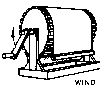
The old time radio shows used wind machines for Superman
flying, storms and spooky backgrounds. The sound is produced
by rotating a drum of wooden slats against a canvas sheet
that is pulled lightly against the slats. It's not too tough
to make your own, but will require some carpentry skills. I
made one in an afternoon out of plywood and a 1 -1/2 inch
closet pole dowel. Total materials cost: $20.
My drum was 12 inches in diameter and 16 inches long. For the ends of the drum, I bought two pre-cut 12-inch circles of 3/4 inch particle board at a building supply superstore (Home Depot). I drilled two 1-and-7/16 holes in the center of the circles and filed it so allow a tight fit for the closet pole--which serves as the axle. I then cut 18 slats - 1-inch wide by 16 inches long, from a piece of 1/4 inch plywood.
NOTE: The slats must be of a fairly hard wood or they won't be loud enough when rubbing against the canvas sheet. I used tiny nails to attach the slats to the circles leaving about an inch of space between them. Try to have the slats equidistant from each other--so as to avoid an irregular rhythm when they rub against the canvas. Nail one then it's polar opposite and continue by halves, quarters, eighths, etc., until the drum is covered with slats. You may want to apply emory boards or sandpaper strips on some strips to increase the friction--and thus, the volume.
I built the drum platform out of a 20 inch by 16 inch rectangle of 3/4 plywood and used two triangles to serve as braces for the drum. The dimensions depend upon how much axle you use. (Sorry I can't be more precise, but I don't have the machine beside me).
For the axle, I used a 1 -1/2 inch closet pole and cut it to about 19 inches. I used one of those plastic end-caps for hanging closet pole to hold the axle on one end of the dowel and just drilled a 1-and-9/16 hole through the other brace. The drum is attached to the axle just where it goes through the circles. The crank was just a short piece of 2 x 5 inch plywood with a bit more dowel for a handle. I attached them with several screws.
I used a cut up "butterfly chair" seat for the canvas sheet. It is wrapped around an extra slat at either end (like an old roll-up window shade) and secured against the platform on one end only.
The cranking motion really makes the device slip around, so I cut out a piece of a thin rubber-backed welcome mat and attached it to the bottom of the platform--carpet side facing the bottom of the platform--rubber side facing whatever tabletop surface you put the device on.
To get the wind sound, you crank SLOWLY and, if you want, pull the canvas tighter against the rotating drum. You don't have to crank too fast to get a convincing wind storm.
You can also leave the canvas away from the slats and apply other things (playing cards, a drummer's wire brush, etc.) against the rotating slats to get other mechanized sounds.
My table-top wind machine isn't too loud so I always mic it very closely, but it really produces that classic
dust storm or Superman flying sound. It's an amazing little
contraption.
The walk board is used for running, walking, dancing,
and even dragging ghostly chains on. I use a piece of 2 foot
by 3 foot plywood, doubled up (two 3/4 inch pieces attached
on top of one another). You may want to cover one side with
tile or carpet. We have people walk and stomp on the board,
but noticed that many people wear athletic shoes which don't
make much noise. You could get some leather soled shoes and
walk them on the board with your hands-but I don't bother--I
just have people stomp louder. If you prop up one end of the
walk board with a two by four, you can simulate a stair step
sound.
The gravel box is generally used for horse hoofs and
walking. I use an 18 inch by 30 inch wooden box (I made it
from
1 x 6's and plywood) filled with a layer of garden gravel.
We then use two coconut shells for horses and two
two-by-four blocks (7 inches by 4 inches) as cowboy
"boots" to walk on the gravel. Some old shows used a canvas
bag filled with gravel, but we've found the box
sufficient--also having the gravel exposed allows us to
manipulate it for other sounds--such as Crusaders wading
through an ocean of bones. I recently added a small plywood
"deck" covering part of the box to use for streets or bar
room floors. A piece of ceramic tile might help for
cobblestones. Some wooden "boots" had spurs too. Hi-Yo,
Silver!
A couple of years ago, I investigated using real telephones for phone SFX and can't recommend it.. The way an old Bell phone works is that two voltages levels are run through the same two copper wires. I don't quite recall the exact low voltage, but I think it was something like 15-20 volts for the talk signal and 84 volts for the ringing. But to generate that 84 volts you need an expensive transformer. I just thought it was too much money and too dangerous to use with kids.
So, here's what I recommend instead: Go to a hardware store and buy a doorbell kit--not the "Ding Dong" variety, but the little 3 inch bell with a clapper. It's about $10-$15. Then mount it on a board and remember to push the button 2 seconds on and 4 seconds off. If you get the right kind of bell, it works fine as an old phone. I also keep an old-style desk phone nearby so people can loudly pick up and put down the handset in conjunction with the bell.
What I don't have is the sound of the bell ringing
through the phone line--what YOU hear when you're
waiting for somebody you've called to answer. So I always
have characters dial or answer the phone and only put one of
them through an EQ filter to simulate the "tinny" sound of a
phone voice..
Take an old fashioned kid's roller-skate and attach it to the bottom of a wood box (10 x 4 x 4). The old skate should be the kind that would strap onto a kid's shoe and use four metal wheels--you want something noisy, not fancy. This can serve as a horse-drawn buggy, an elevator door opening, a double-sash window opening and even the creaking of a sailing ship at sea. You can put chains or gravel in the box to jostle around too.
You can buy these plastic egg maracas at musical
instrument stores or make your own out of egg sized plastic
Easter eggs filled with seeds or rice. Get two and shake
them very fast, then vocalize some jungle bird sounds and
you've got an instant rainforest. This is very evocative.
Bang together several large metal cooking spoons and pancake flippers. I like the flipper with the wooden handle and a 10 x 3 inch blade. The metal spoons can be plain or have strainer holes. The crash box and some battle cries add extra mayhem too.
Get one of those plastic 5 gallon paint buckets fill it
one third full and swish water around inside. This can serve
as rowboat oars or swimming or sharks. A plumber's plunger
can work as a swish stick, but what's better is an "X"
shaped cross of 1/4" plywood on the end of a stick. To get
the sound of a splash you don't plunge into the
bucket--that's splash water all over you--instead you put
the X-stick into the bucket and pull it out.
That's how they did on the Lone Ranger. Plus you can
use the bucket to carry around other small SFX gear. I also
bought a little lid/seat for $5 that fits over it, so I can
sit on it during any stretches of a show where there are no
sound effects.
The typical office clipboards can be snapped to make decent gunshot noises. I find the wooden backed ones to be noisier. I think they really need a resonating box to amplify the sound. Maybe snapping the clipboard in a small metal trash would work. Another idea is to use a drum stick to hit a throw pillow or vinyl covered drummer's throne--however this requires some skill to slam the body of the stick onto the pillow. If you're not precise with your hits, you might end up shooting "blanks" when real bullets are called for.
Lately, I've found an old CBS gunshot slapper that's pretty easy to make. The concept is to slap a hinged ruler-sized "tongue" of 1/4 plywood on a small 12"x4" pad of chamois--that goat skin drying rag sold at auto part stores. I take a 13"x5" platform of 1/4 plywood, affix a small cabinet hinge on one end, attach the 2"x11" ruler/tongue to it and staple a folded bit of chamois under it. Then you pull back the tongue and slap it for the gun shot. It works really well in a theater and can be "fired" repeatedly. If you add some reverb to the sound in post-production, it's a convincing gunshot.
To produce the sound of surf lapping at a beach, get one of those black plastic witches' caldrons they sell to hold candy at Halloween and pour in a few handfuls of BBs, then slosh them around. You'll have to use two hands to control this sound, but it's very realistic. I've tried it with marbles instead of BBs, but the marbles clack into one another and spoil the effect. Find a cauldron that's smooth inside, so the BBs won't bump or stick when you start sloshing them around. You can find the BBs at gun shops for about $3 for a 1/2-pint milk box. Look for "Airgun shot, steel BB Caliber (4.5mm)."
The REMO drum company makes a commercial wave drum with two different surfaces. They run about $50. You could make your own by rolling the BBs in an 18-22 inch bass drum rim and drum head.
While you can try the typical prop doors used in stage plays, I suggest you build a small SFX door to stand on the SFX table. For photos of my SFX doors, see: www.ruyasonic.com/ruya_news.htm
You can make a small door from a single panel off an old 4 or 5 panel door--which can be found at architectural salvage yards. Build a frame out of 1”x6” pine. Use 2-1/2” non-mortise hinges. What’s important for a good SFX door is to use an old-style mortise lockset. Search at Amazon.com or Google for:
“Mag Engineering” #8785 Brass Mort Lock. The lockset and strike are more important than the door dimensions. Attach 1”x3” wooden feet to the frame so it can stand upright. Clamp those feet to the SFX table so the door won’t rock when you slam it.
Jiggle mortise-style door knob to get a “ka-CHINK.” Again, the old-style mortise lockset produces a clearer “door” sound than modern (a/k/a “Kwikset”) locksets--which are too quiet.
Ring a small “tea time” bell or similar. This bell “hangs” on the lobby door of the Savings & Loan office and is heard when Violet makes her entrance and exit while seeking a letter of recommendation from George. Coordinate the bell to ring when the door opens/shuts. Do NOT attach it to the door---just open the door with one hand and ring the bell with the other. Search Google for: “tea bell” and find one with a 1” or 1-1/2” or so diameter.
Scrape a fork on small dessert plate. You may wish to drop the fork on a particular line of dialogue--for dramatic emphasis. Have two or three different sized plates/saucers and several forks--so you can quickly grab one on a crowded SFX table.